June 10, 2026 · 18 min read
Google's three AI faces: AI Overview, AI Mode, and the Gemini App
AI Overview, AI Mode, and the Gemini App all run on the same Gemini engine — yet they have different entry points, trigger logic, citation mechanics, and monthly active users that differ by an order of magnitude. This piece untangles the three surfaces, explains why there is no API and why real feedback only comes from production-grade SERP observation, and lays out a differentiated GEO/AIEO strategy.

Search is fragmenting. A decade ago, “being seen on Google” meant one thing: fighting for a high spot among the ten blue links. Today the same query can land in three completely different AI surfaces — all driven by the same model family (Gemini), yet with different entry points, different trigger logic, different citation mechanics, and user bases that differ by an order of magnitude.
If you’re still using the catch-all term “Google AI” to plan your content and visibility strategy, you are almost certainly spending budget in the wrong places. This article does three things: it cleanly separates the three surfaces by behavior and scale, it explains why there is no API — why real feedback can only be obtained through production-grade SERP observation — and it turns those differences into a concrete, differentiated GEO strategy.
1. Three surfaces, one engine: the essential differences
First, clear up a common confusion. Many people use “AI Overview, AI Mode, Gemini” interchangeably in the same breath — they are not the same thing. The accurate relationship is this: Gemini is the underlying model and ecosystem, while AI Overview, AI Mode, and the Gemini App are three product surfaces built on that engine, each aimed at a different intent.
Gemini itself is the multimodal model family developed by Google DeepMind (Nano / Flash / Pro / Ultra tiers). It refers both to the models and to the product suite built on top of them. The three surfaces above each make different tradeoffs across three layers: model + retrieval + presentation.
| Dimension | AI Overview | AI Mode | Gemini App |
|---|---|---|---|
| Form | An AI summary box at the top of the regular search results page | A full conversational search interface | A standalone chat assistant / agent |
| Entry point | Appears automatically above ordinary Google results — nothing to turn on | A dedicated tab / mode inside Google Search you opt into | Standalone app (iOS/Android), gemini.google.com, Android system-level assistant |
| Traditional results | Preserved — organic links, video, and People Also Ask still sit below the summary | The ten blue links are dropped in favor of a synthesized answer + citations | No search SERP at all — direct conversation |
| Trigger | High-confidence queries judged by the system (mostly informational, how-to, product) | The user opts in, for complex, multi-step, exploratory queries | The user starts a conversation |
| Retrieval | Custom Gemini + query fan-out + Knowledge Graph + live web + shopping data | Query fan-out (up to ~16 concurrent sub-queries in one pass) + live multi-source retrieval | Model capability by default; can call search grounding |
| Default model | Custom Gemini (evolving by version, 2.0 → 2.5 → 3.5 series) | As of I/O 2026, the default is Gemini 3.5 Flash | Current Gemini in-app (3.x series); Deep Think for Ultra users |
| Relationship to the user | ”Quick conclusion” — gives you the gist, no click required | ”Deep exploration” — back and forth, follow-ups allowed | ”General assistant” — writing, coding, planning, agent tasks |
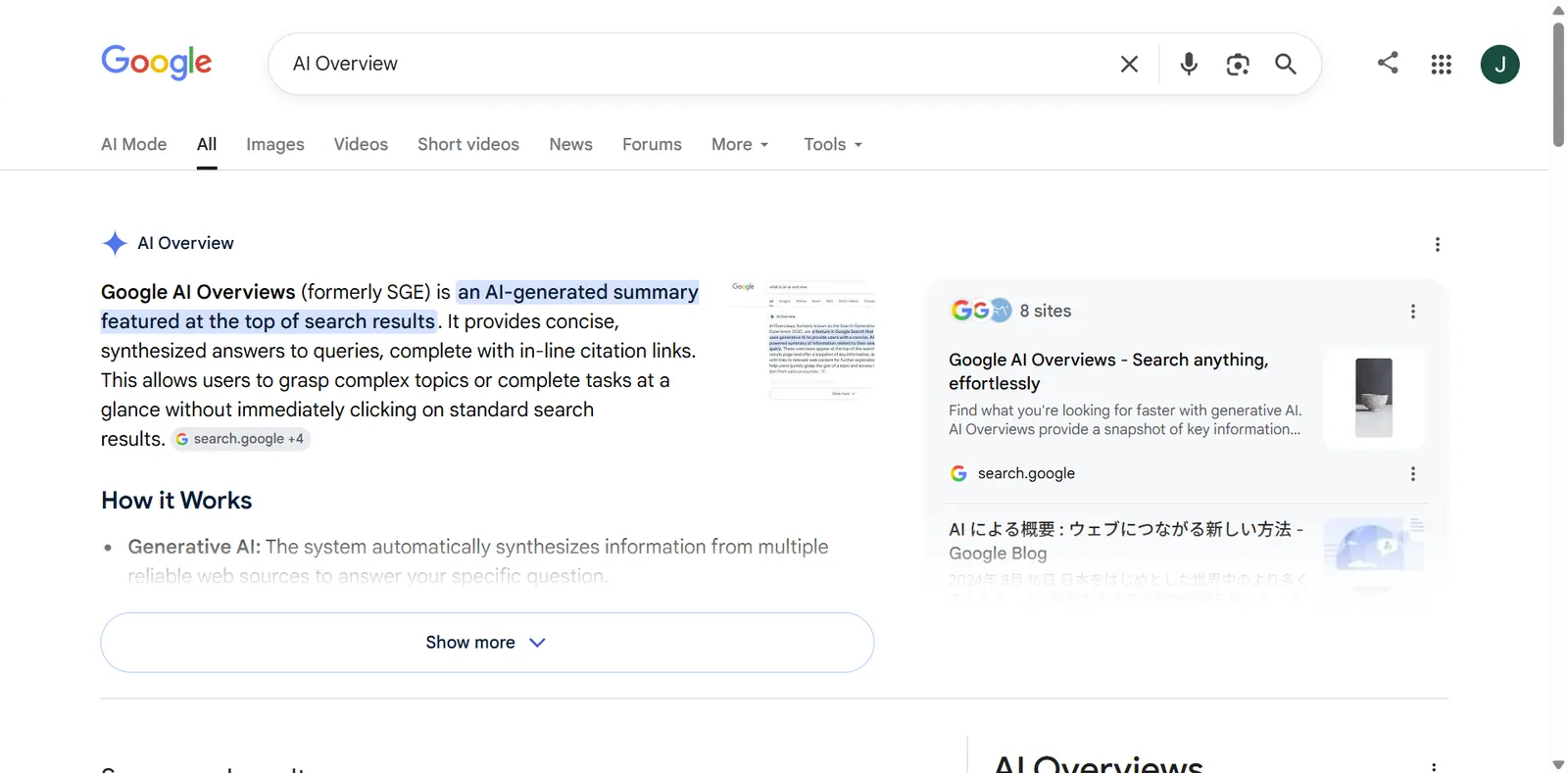
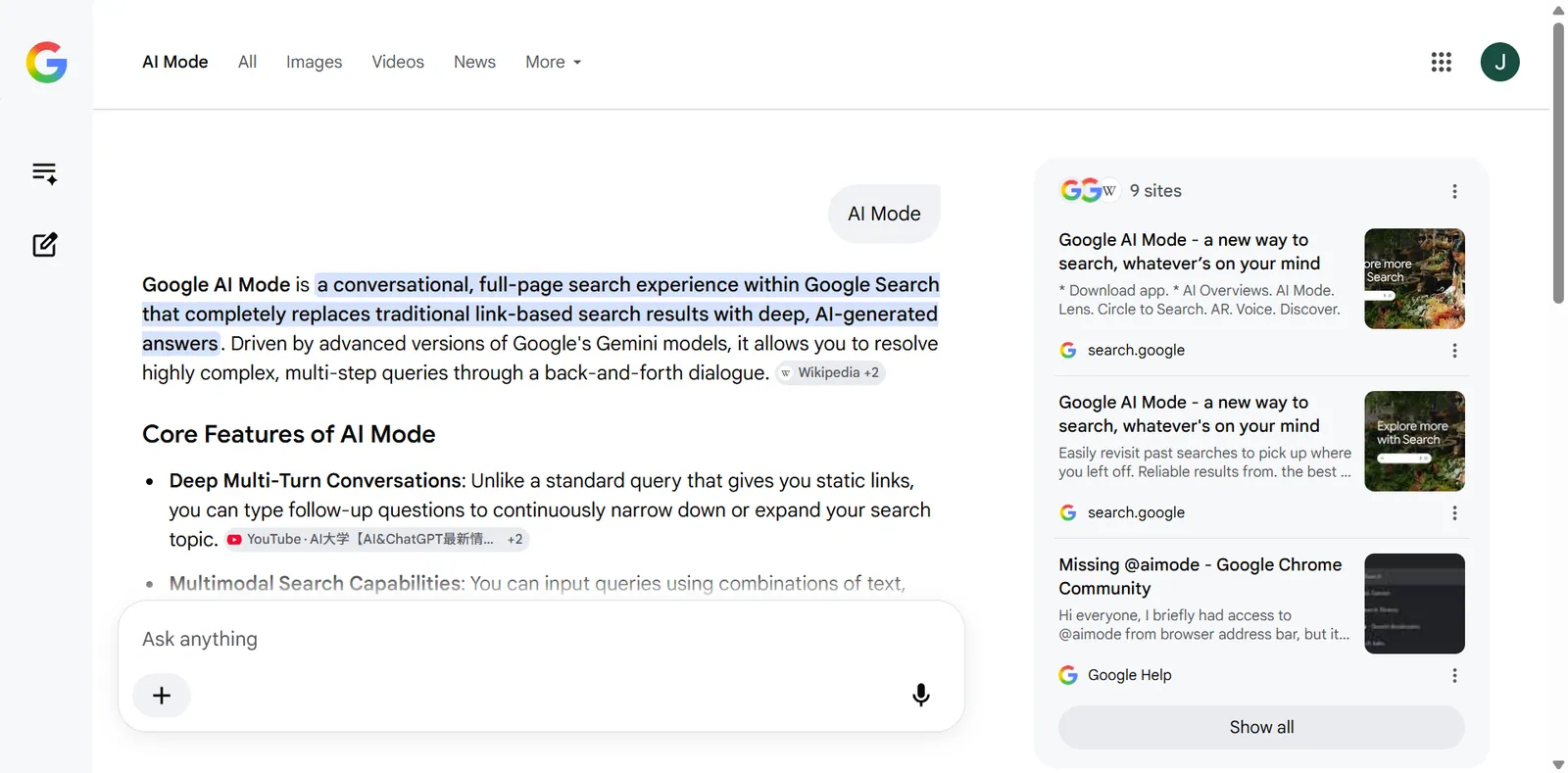
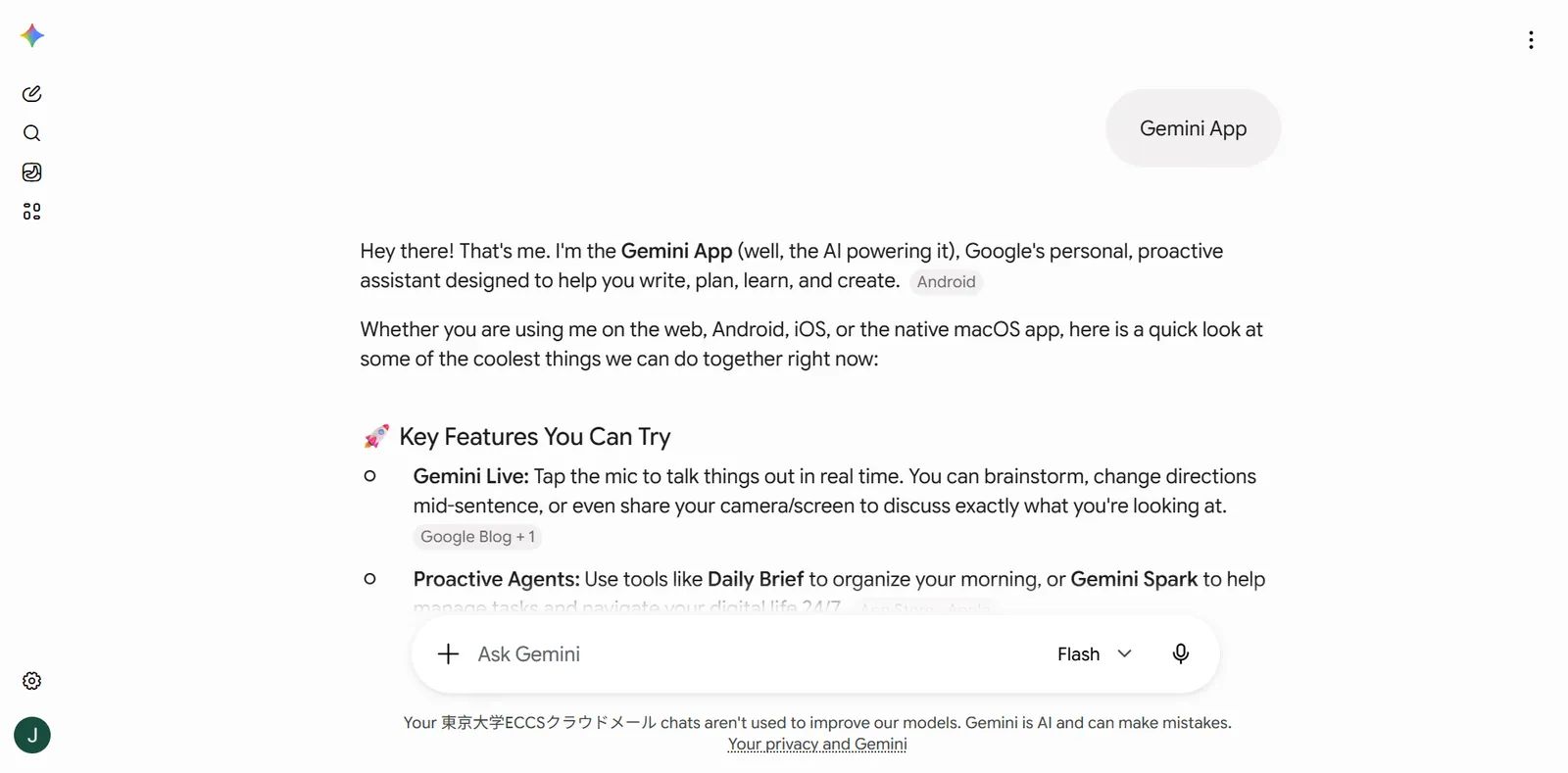
Here’s what each of the three faces actually looks like today:
AI Overview: the largest and most “passive” surface
AI Overview is not a standalone model — it’s a search feature built on Gemini. Its core is query fan-out: it breaks your single search into multiple related sub-queries, retrieves concurrently across web pages, the Knowledge Graph, product data, and other sources, then synthesizes the results into a summary with citation chips. Google’s own materials give an example — when you ask “what’s the difference between smart rings, smartwatches, and sleep mats for sleep tracking,” custom Gemini first plans, then retrieves in parallel, then dynamically adjusts the plan based on what it finds.
The key trait: it is default and passive. The user makes no choice; qualifying queries automatically get an AI summary on top. That’s the root reason its scale dwarfs the other two.
AI Mode: the most ChatGPT-like, fastest-growing surface
AI Mode is an end-to-end conversational search experience, powered by Gemini, delivering synthesized answers with citations — but it drops the traditional ten blue links, making it interactively closer to ChatGPT or Perplexity. It also uses query fan-out, at an even larger scale (industry observation puts it at up to ~16 concurrent sub-queries per pass). It targets the complex, multi-step queries where “one answer isn’t enough,” and it increasingly carries transactional capability — through the Universal Commerce Protocol (UCP), users can browse products and complete a purchase right inside AI Mode.
Gemini App: a general assistant, orthogonal to search
The Gemini App is Google’s standalone AI assistant (formerly Bard), which on Android also exists as a system-level floating assistant; on the developer side it’s accessed through the Gemini API and Vertex AI. For GEO strategy it is largely orthogonal — it’s not a search SERP, and by default it doesn’t depend on live retrieval and citation the way AI Overview / AI Mode do. In other words, the visibility optimization you do for the search surfaces does not automatically carry over into the Gemini App’s answers, and vice versa.
2. Monthly actives and strategic weight: an order of magnitude apart
Scale dictates priority. The figures below come from Alphabet’s earnings, Google I/O 2026, and reporting from major tech outlets — use them to sequence where your GEO resources go.
- AI Overview: ~2.5 billion MAU. Per Sundar Pichai at Google I/O in May 2026, AI Overview’s monthly actives have passed 2.5 billion. Tracing the growth: ~1.5 billion in May 2025, widely reported at ~2 billion by late 2025 / early 2026, then 2.5 billion at I/O 2026. This is one of the widest-reaching AI information distribution layers on the planet.
- AI Mode: 1 billion+ MAU. At I/O 2026, Google announced AI Mode had passed 1 billion monthly actives and upgraded the default model to Gemini 3.5 Flash, covering nearly 200 countries/regions and 98 languages. Its growth is very fast — Google says query volume has more than doubled each quarter since launch. AI Mode first appeared in May 2025 with limited early penetration (a16z’s consumer-AI analysis once put it at ~2% of weekly active users), but the growth curve is steep.
- Gemini App: ~750 million MAU. Per Alphabet’s Q4 FY2025 earnings (released February 4, 2026), the Gemini App passed 750 million monthly actives — a sharp jump from ~450 million at the start of 2025 — with analysts expecting it to cross 1 billion in Q3 2026. For comparison, ChatGPT’s monthly actives were estimated at ~810 million in late 2025.
One development that matters enormously for GEO: on May 19, 2026, Google announced it would merge AI Overview and AI Mode into “one seamless AI search experience.” This means the boundary between the two will blur over the coming quarters — but the optimization work doesn’t disappear. If anything, it makes a unified, cross-surface view of visibility even more necessary.
The bottom-line call: in pure traffic reach, AI Overview is the one to watch today (it’s already eating your clicks); AI Mode is what defines visibility tomorrow (conversational, transactional, fastest-growing); and the Gemini App is a separate citation pool that needs its own strategy. All three must be tracked separately.
3. Why this is the watershed for GEO/AIEO
Traditional SEO aims for “ranking.” GEO (Generative Engine Optimization) / AIEO aims to “get cited” — to have the AI select and attribute your content when it generates an answer. The gap between the two is on full display in AI Overview.
First, the citation itself is a business outcome. Multiple industry studies point the same way: pages cited in AI Overview earn significantly more clicks than those that aren’t. One widely cited figure: being cited drives roughly 35% more organic clicks and 91% more paid clicks. The direction is consistent and the magnitude varies by study — but “cited vs. not cited” has become the new deciding factor.
Second, visibility has become highly unstable. Unlike traditional rankings, which are relatively stable, AI citations swing violently — multiple studies show a brand’s AI citations can fluctuate 40%–60% month over month. This means a single snapshot is meaningless; what you need is continuous, cross-region, cross-surface sampling and trend analysis.
Third, triggering is selective. AI Overview doesn’t appear for every query — it primarily targets informational and how-to queries, and usually requires a clear consensus across multiple authoritative sources. That forces a GEO team to first build a “trigger profile” — figuring out which of your target queries fire an AI surface and which are still classic SERP.
Put the three together and the conclusion is clear: you cannot manage what you cannot see. The first step in GEO isn’t writing content — it’s building a capability that can stably and at scale “see the AI answers.” And that turns out to be far harder than most people imagine.
4. The core of simulation: no API — real feedback only comes from production-grade SERP observation
There is no API — and there’s no workaround
Many engineering teams’ first instinct is to hunt for an “AI Overview endpoint” on OpenRouter or the official Gemini API. That road is a dead end, with no workaround. Neither AI Overview nor AI Mode is an externally exposed model endpoint — they are features inside Google’s search product, equivalent to custom Gemini + live retrieval + query fan-out + a citation stack. Any model API gives you only the bare Gemini model, missing that entire downstream retrieval-and-ranking machinery — what you get back is nothing like the box on the search page.
So the conclusion is hard: the only path to seeing the real AI surface is to actually run searches and observe the results stably. There is no second way.
The hard part isn’t “scrape once” — it’s “real” and “at scale”
But “run a search once” and “get trustworthy, real feedback” are separated by an entire engineering chasm. The output of AI surfaces is highly context-dependent:
- Region, language, and device change whether it triggers, what it triggers, and whom it cites;
- Login state, account history, and personalization make the same query give different users different answers;
- Load state means the AI summary is sometimes returned in the first paint, sometimes injected asynchronously, sometimes returned only as a short-lived token;
- Triggering itself is selective — only some queries surface AI;
- Citations swing violently — up to 40%–60% month over month.
This means: what you get from a single IP, a single environment, a single scrape is only a “lab view” — it tells you “what Google gave under one specific condition,” not “what tens of millions of real users see in the real world.” For GEO decisions, the former is nearly worthless.
Genuinely usable real feedback has to be built on a massive, independent, real set of environments and sessions: enough independent environments to cover the distribution of region and personalization, sessions real enough to trigger the side Google shows real users, and sampling stable enough to cut through the selectivity of triggering and counter the volatility of citations. This is not something a script can solve — it is infrastructure that requires sustained investment.
vereach has turned it into a production-grade capability
This is exactly where vereach stands. In the absence of an official API, vereach has built production-grade SERP observation infrastructure — not an ad-hoc script, not a single-point scrape, but a system that runs stably, scales, and produces reproducible output.
Its foundation is a massive base of independent environments and real sessions. Through a large number of independent, real environments distributed across different regions, languages, devices, and personalization conditions, vereach captures the side Google actually shows real users: covering every load state of the AI summary, reconstructing the differentiated results across region and personalization, and cutting through volatility with sufficient sampling density. This is a class of real feedback that very few vendors can obtain stably — most tools either stay at a single-perspective snapshot, or can’t penetrate personalization and trigger selectivity, ultimately delivering only an “approximation.” And approximation is exactly what GEO decisions can least afford to rely on.
The authenticity of the underlying data determines the credibility of every conclusion above it. This is also the first-principles question of GEO: is the feedback you’re holding actually feedback from the real world? vereach lays that foundation solid first; only then do the monitoring, diagnosis, and strategy on top of it hold up — whether your brand is or isn’t cited in real users’ AI answers, in which regions, and relative to which competitors, the answer is finally trustworthy.
5. Three surfaces = three intents = three GEO strategies
The central argument of this article is: because the three surfaces serve different user intents, they require different optimization strategies, different query-simulation methods, and even different success metrics. Applying one set of queries and one playbook to all three surfaces is GEO’s most common — and most expensive — waste.
AI Overview — the battle at the awareness layer
- Intent: the user wants a “quick conclusion” — informational, how-to, category-awareness queries.
- Strategy: write content as “directly excerptable conclusions + clear structure + verifiable facts,” so the model can easily lift your passages when synthesizing; and establish consistent factual statements across authoritative third-party sources (reviews, directories, industry sites), because the AI’s “factual bedrock” often doesn’t come only from your own site.
- Query simulation: seed with short questions, how-tos, and category terms, focusing on simulating the breadth of the fan-out — which sub-questions a category term gets split into, and whether you have coverage on all of them.
- What to watch: whether an AI summary triggers, whether you make the citation chip, and how competitors hold the slots.
AI Mode — the battle at the decision and conversion layer
- Intent: the user is doing “deep exploration” — complex, multi-constraint, comparison, decision, and even transactional queries.
- Strategy: organize content around “comparison matrices, fit scenarios, constraints” (“the Y that suits X-type users”), so you get hit repeatedly across multi-turn follow-ups and large fan-outs; and prepare structured product/service information for the transactional path (UCP and the like).
- Query simulation: seed with long-tail, multi-constraint, comparative queries, and simulate the conversation chain and a larger fan-out — are you still present in the second and third questions after a follow-up?
- What to watch: whether you’re selected in the synthesized answer, whether you make the recommendation set, and whether you can enter the transaction/action path.
Gemini App — the battle at the authority and ecosystem layer
- Intent: general assistant and agent tasks, orthogonal to the search SERP.
- Strategy: this is a separate citation pool, driven by cross-web brand authority and consistent signals (being mentioned across many sources, over a long time, stably) — not single-page SEO; the goal is to make the model “know and be willing to recommend” you even without live retrieval.
- Query simulation: use open-ended, recommendation-style, task-style prompts to ask the model (or a grounded model) directly, rather than scraping a SERP — because here there is no search results page at all.
- What to watch: whether the brand is proactively mentioned/recommended, its position in the recommendation list, and whether the framing is accurate.
From “monitor everything” to “monitor by focus”
Put those three sections together and a judgment emerges: the three surfaces differ in scale, intent, and playbook, so “monitoring everything uniformly” is both expensive and unfocused. What you actually need is to first decide which business problem you’re solving this time, then decide which surface to watch, which query set to use, and what diagnostic conclusion to output.
This is precisely vereach’s design orientation for GEO — focus-based. Rather than dumping a pile of undifferentiated citation counts on you, it organizes monitoring around a Focus, and the rule is concrete: one Focus tracks exactly one archetype — one class of question-form — so its query set stays homogeneous and a single KPI family reads it fairly. vereach ships eight archetypes (category recommendation, head-to-head comparison, brand-direct reputation, factual accuracy, campaign/freshness, authority/citation, differentiation salience, intent coverage), each carrying a brand guardrail (whether your brand or a competitor may, must, or must not appear in the query) and its own KPI family.
You pick the archetype that matches the business question you’re answering; vereach then does targeted monitoring on the most relevant surface and outputs the corresponding diagnostic report, telling you “on which surface, on which queries, relative to which competitors, you are cited or absent,” and what to shore up next. In other words, it upgrades “watching rankings” into “watching the business.”
Generalizing, the three surfaces each naturally fit different archetypes:
| Surface | Naturally fitting archetypes | Typical diagnostic question |
|---|---|---|
| AI Overview | Awareness layer — category-recommendation / authority-citation / intent-coverage (brandless category & topic questions) | “On my core category questions, who does the AI summary cite? Where am I absent?” |
| AI Mode | Decision & conversion layer — head-to-head comparison / differentiation-salience (named, comparative, transactional queries) | “In multi-turn decision conversations, do I make the recommendation set, and can I reach the transaction path?” |
| Gemini App | Authority & ecosystem layer — brand-direct reputation / authority-citation (proactive recommendation in assistant scenarios) | “When a user asks for a recommendation without retrieval, will the model proactively and accurately mention me?” |
When you align archetype → surface → KPI family by Focus, monitoring stops being a heap of floating numbers and becomes a diagnosis that points straight to action. And its precondition is still the line from section 4 — what you capture underneath has to be real feedback. A diagnosis built on production-grade real data and then aligned to a business focus is the only kind that’s trustworthy. vereach’s GEO solution brings those two together.
6. Looking ahead: where GEO goes in 2026–2027
Three trends worth positioning for now:
- Surface convergence. AI Overview and AI Mode are merging into a unified AI search experience. In the short term, “tracking each surface separately” is still necessary, but in the medium term a unified, cross-surface visibility metric will replace any single surface’s citation rate as the new north star — and that requires an observation framework that can align across surfaces by focus.
- The agentification and transactionalization of search. The theme of I/O 2026 was the “agentic Gemini era” — search is moving from “answering questions” to “completing tasks for you,” embedding transactions into the conversation via protocols like UCP. This means GEO’s battlefield expands from “informational queries” to “transactional/action queries,” and being selected by an agent as an execution step becomes a new form of visibility.
- Further concentration of the distribution layer. Gemini is penetrating billions of devices through Search, Android, Chrome, Workspace, and even its partnership with Apple. The compounding effect of being cited by the Gemini ecosystem will only grow — the citation-source authority you build today is an asset for tomorrow’s cross-surface visibility.
The essence of GEO/AIEO is shifting from “make the search engine rank you” to “make the AI trust and attribute you when it generates an answer.” And trust begins with being seen. Building a stable, cross-surface, volatility-resistant AI-answer observation capability aligned to your business focus is the first step in all of it.
Want targeted monitoring and a diagnostic report under real-world conditions, aligned to the archetype that matches your business question? See how vereach helps you get seen in AI answers.
A note on methodology: the user scale, model versions, and product developments cited here come from Alphabet’s earnings, official information from Google I/O 2026, and public reporting by major tech outlets (as of June 2026). AI surfaces evolve fast — verify against the latest official guidance before any key decision.